Wednesday, October 31, 2012

Happy Halloween!


Well, I had a nice low-key Halloween this year. We stayed in and ate vegan chili dogs and watched old scary movies. It was fun.
   
Vegan chili dog


Carob covered walnuts
We had a couple of treats too: pumpkin bread and carob covered walnuts. I thought I’d share the recipe for the former below, and as for the latter, it couldn’t be simpler: Just melt carob or chocolate, stir in some nuts, then just dump the whole thing onto wax paper and spread out and separate with your fingers. Then let harden for about 15 minutes. It’s quite a bit faster and easier than trying to dip the nuts individually and tastes just as good.


Pumpkin spice bread
Pumpkin Spice Bread

Dry ingredients:
1 ½ cups whole wheat pastry flour
½ cup oat bran
1 cup sugar or sweetener
1 tbsp chia seeds or ground flax seeds (optional)
2 ½ tsp baking powder
½ tsp baking soda
¼ tsp salt

Spices:
1 tsp cinnamon
½ tsp nutmeg
½ tsp ginger
½ tsp dried orange zest
½ tsp cardamom
¼ tsp coriander
¼ tsp allspice

Wet ingredients:
1 ½ cup pumpkin puree (one 15 oz should cover it)
1/3 cup oil
¾ cup soymilk
2 tsp vanilla
½ tsp maple extract

2 tbsp finely chopped crystallized ginger (optional)
a handful of dried cranberries (optional)

Directions:
Preheat oven to 350 degrees F.
Whisk together all dry ingredients, including spices. In a separate bowl, stir wet ingredients together. Combine two mixes, taking care not to over-mix. Add cranberries and ginger if using.

Spray a 9 by 5 inch loaf pan with cooking spray. Pour batter into pan and bake for about 55 minutes, until a toothpick comes out fairly clean.


Variations: 
You could change the add-ins, replacing the cranberries and ginger with raisins, nuts or chocolate chips.
Coconut might be interesting too.

You could also use another pureed fruit or vegetable in place of the pumpkin, such as mashed sweet potatoes or bananas or apple or pear sauce.

Pumpkin bread slices

Wednesday, September 26, 2012

Pear-Almond Crisp


Here is a nice autumn dessert. The almonds and pears’ mild flavors combine beautifully for a very delicate dessert. I happened to have a counter full of rapidly over-ripening pears, so a giant crisp was in order, but feel free to halve the recipe if you lack such a bounty.

Don’t peel the pears—the peels contain a fair amount of the pears’ flavor and aroma, and also help with structural integrity.

Pear Almond Crisp

Pear-Almond Crisp

Fruit filling:
About 12 pears (depending on size)
2-3 tsp cornstarch (more or less based on ripeness of pears)
4 tsp lemon juice
¼ tsp vanilla
dash of cinnamon
2 tbsp sugar or sweetener
2 Tbsp crystallized ginger, finely chopped

Topping:
2/3 cup whole wheat pastry flour
1 cup oats (I used quick oats)
1/3 cup almond meal
2-3 Tbsp slivered almonds
2/3 cup sugar or sweetener
1/8 tsp salt
1 tsp cinnamon
¼ tsp nutmeg
¼ tsp cardamom
1/3-1/2 cup oil
½ tsp vanilla

Mix together all the dry ingredients for topping. Stir vanilla into 1/3 cup of oil and drizzle into dry ingredients while tossing with fork. Squeeze and toss with fingers until mixture looks and feels like crumbly wet sand, adding some or all of the rest of the oil if necessary.

Cut pears into half inch slices, then cut slices in half into chunks. Chop ginger and set aside. Whisk together rest of filling ingredients and gently toss with pears. Spray a 9 by 13 inch baking pan or casserole dish with cooking spray.  Pour pears into baking pan and spread out. Sprinkle ginger evenly over top, then sprinkle on topping mixture.

Bake at 425 degrees F for 25 to 30 minutes.

Makes 12 generous servings. 


Two Vegan Pesto Recipes (and how to design your own)


Pesto is one those foods I never tried before going vegan, and it made a pretty big impression the first time I did.  Pesto is a rich, intensely flavorful sauce made primarily from a combination of herbs, nuts, and oil. The difference between traditional and vegan pesto recipes is generally the inclusion of parmesan cheese, which can be substituted for with extra lemon juice, a pinch of salt, and a higher proportion of nuts. Nutritional yeast may also be helpful.

I like to decrease the fat by replacing some of the traditional oil with warm water.  This makes the sauce a little lighter, which means you can eat more of it. And that's good thing, because you’ll want seconds once you taste it. : )  

Vegan Pesto Sauce


Parsley Walnut Pesto

5 cups fresh parsley, roughly chopped
2/3 cup walnuts
3 Tbsp lemon juice
1 Tbsp minced garlic (more or less to taste)
1 Tbsp oil
1-2 Tbsp nutritional yeast (optional)
up to ½ cup warm water (or more oil, if you like)
salt and pepper to taste

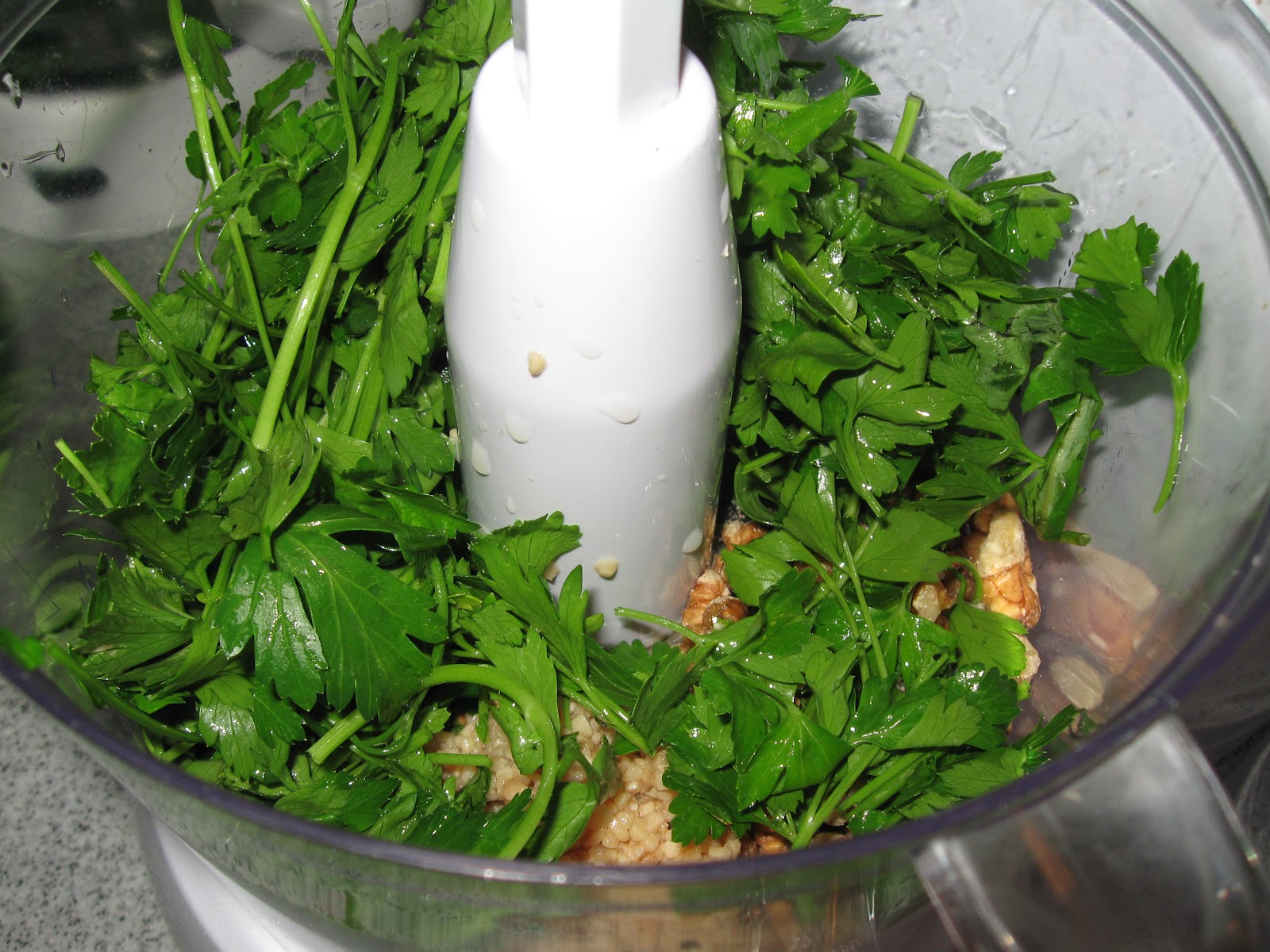
Waiting in the food processor
Place parsley, nuts, lemon juice, garlic, yeast, and 1 tbsp oil in food processor or strong blender. Puree until fairly smooth. Stop the machine and scrape down the sides with a spatula. Start the machine up again and drizzle the water (or oil) into the chute slowly while food processor is running. Stop when you reach a soft spreadable consistency. Season with salt and pepper to taste.


Kale Almond Pesto

1 large bunch kale
1 cup almonds
¼ cup lemon juice
1 heaping Tbsp minced garlic (more or less to taste)
1 Tbsp oil
1-2 Tbsp nutritional yeast (optional)
up to ½ cup warm water (or more oil)
salt and pepper to taste

Wash and de-stem kale. Steam or microwave kale until it turns bright green and tender. Place cooked kale, nuts, lemon juice, garlic, yeast, and 1 tbsp oil in food processor and blend. Pour in water or oil slowly while machine is running, scraping sides once or twice. You may need less water/oil depending on how much water the kale absorbs while cooking, so go easy.

Now that you have pesto, what do you do with it? The most common way to serve it is over pasta, preferably a shape with lots of crevices to catch sauce in. It can also be used in sandwiches, particularly grilled ones, and makes an excellent pizza sauce. I’ve also seen it used in various salads, including potato salad and cold pasta salad.

My favorite pesto meal is curly pasta tossed with pesto and Italian flavored white beans:
 

Italian Flavored White Beans


2 15 oz cans white beans, drained and rinsed
1-2 tsp oil (more if you like)
1-2 tbsp lemon juice
1-2 tsp minced garlic
½ tsp Italian seasoning
¼ tsp dried basil
salt and pepper to taste

Mix all ingredients together and heat until warm in microwave or on stovetop
If you like, you can pre-sauté the garlic in the oil before adding the rest of the ingredients, but it’s not totally necessary.

Toss with pesto and your favorite pasta.
Pasta with Pesto and White Beans


Variations:

Traditional pesto: Using the parsley/walnut recipe, substitute fresh basil for the parsley and pine nuts for the walnuts. You might want to make a half recipe because of the increased price of ingredients, and because it won’t last as long due to the basil’s tendency to oxidize.

Build your own Pesto:  Fresh greens that can be used as pesto bases include the aforementioned basil and parsley, arugula, cilantro, watercress, mint or spinach . So can cooked greens such the kale above as well as collards, chard, mustard greens, etc. Even cooked vegetables outside the category of greens can be used, such as peas, asparagus, or edamame—these usually require less nuts and oil to achieve a creamy texture when blended. I’ve even seen seemingly unrelated veggies such as sun-dried tomatoes made into pesto.  For the nuts, virtually any type of nut or seed works, although some combinations play better with other ingredients than others. Mild flavored almonds and hazelnuts go with almost anything, but strong flavored nuts or seeds go best with more assertive greens. Toasted nuts can be used as well. Sunflower seeds or (shelled) pumpkin seeds can be used for a nut-free pesto—the pumpkin seeds in particular are often paired with cilantro.  Sometimes avocados or olives are used to add richness in place of some or all of the nuts as well.

Freeform Pesto Equation: 
Greens or other veggies (~4-5 parts)
+
Nuts or seeds (~1 part)
+
 flavoring agents such as garlic, lemon, spices (to taste)
 +
 Liquid such as water or oil (~1/2 to 1 part)
 =
 Vegan Pesto!


Have fun!

Yum!


Thursday, August 30, 2012

10-Year Vegan-iversary


Ten years ago this month, I first decided to go vegan. I didn’t mark the exact day because I was not all that optimistic about the venture succeeding. I was a high-schooler, and at the time I was the only member of my family who had ever explored any form of vegetarianism*.


I had spent several weeks reading up on the subject of veganism and the pros and cons thereof, as well as a number of books about specific misdeeds of the modern meat, dairy and egg industries. I read up on nutrition and discovered that contrary to popular belief, vegetarians and vegans were not inherently doomed and sickly, and that there might even be some benefits, health-wise. No matter how much I was mentally leaning in the vegan direction, however, I hesitated to take the final plunge.


Actually, even before the recent spate of veggie-related reading, I had had impulses toward vegetarianism for years. I was always very fond of and empathetic toward animals, and possessed an excessively vivid and gruesome imagination when it came to picturing the process that was required to transform a living, breathing creature into the bloody slab on my plate. However, I continued to grit my teeth and dutifully choke it down, because everyone told me to, because I thought it was necessary for my health, and also because I doubted my ability to make a meaningful difference, in the world at large and in my own life.


I was a somewhat defeatist teenager, you see. My life was far from terrible, but there were a lot of things about it that made me feel powerless. I was not particularly happy at school, where the difficulty of the schoolwork was often far too easy to pique my interest, and yet my chronic illnesses and absenteeism often created huge backlogs of busy work that I would resentfully slog through for hours, mind completely disengaged. I also had some fairly serious health problems that were not fully diagnosed or treated until I was in my twenties—not that I knew that at the time. I thought it was just my lot in life to be severely nauseated all the time, among other issues, and that it simply wasn’t fixable, no matter what I did.


And I was a worrier. I was just well read and informed enough to be deeply concerned about all of the bad things going on around the world, and just as deeply convinced that I couldn’t personally help with any of it. I could not vote (and that rankled, a lot. I’ve never missed an election since I turned eighteen), I had no income to use for charity, I couldn’t rush overseas to get involved in relief efforts—frankly I was too sickly to do much good even with local volunteerism. I was completely powerless, at least as far as my dramatic teenage brain was concerned.


So whenever I considered the potential impact of a vegetarianism, I tended to dismiss the idea that my abstaining would have any significant effect on the industry at large, for I was convinced that I would never have any impact on the world at large, period. And therefore, there was no point in trying. That was the essential fallacy, of course—the idea that a venture must be a guaranteed success (and not just small-scale success, but a worldwide one) to be worth trying in the first place, when any inventor will tell you that failures can be as instructive as successes, or even more so. And I knew this, deep down. I just hadn’t quite built up the courage yet.


So one day, with no fanfare, I sat down to a meal and simply thought to myself, I don’t want to eat that. I don't want to participate in the cruelty involved anymore. And what’s more, I knew I didn’t have to--that there was an alternative lifestyle that I could try. And maybe I would crash and burn within days and fail utterly with everyone pointing and laughing (a common teenage concern). But at the same time, maybe I wouldn’t. Maybe I would succeed. And wasn’t it worth going out on limb for once to find out?


So I did. And of course, ten years of veganism (and several years of adulthood) later, I can look back and laugh at my uncertainties, my wobbly first steps. And I can evaluate what I have accomplished. No, I have not driven the agricultural-industrial complex to its knees. Although I am no longer actively participating in or financing the meat industry with my custom, the lack hasn’t put any meat company out of business. The planet turns on, largely unchanged by the details of one tiny life form and its tiny choices. I have not changed the world. But I have changed my world.—the way I see life and my place in it. And that is worth something, at least to me.


*Now I am one of six—about half.

Sunday, August 26, 2012

Vegan Alfredo-Style White Pasta Sauce


This turned out pretty well. The silken tofu provides creaminess, and the beans lend a heavier texture that clings well to the noodles. The seasonings were chosen for both flavor and color, so feel free to substitute black pepper for the white pepper, etc., if the little black flecks are not a problem for you.


Vegan Alfredo Sauce with Rotini


Vegan White Sauce

1 12 oz packing silken tofu
2 15 oz cans white beans, rinsed and drained
2-3 tsp oil
1 Tbsp lemon juice
1 ½ Tbsp nutritional yeast
2-3 tsp minced fresh garlic
½ tsp onion powder
½ tsp garlic powder
½ tsp salt
up to ½ cup hot water*
White pepper and more salt to taste


Directions:
In the food processor
Place all ingredients except water in a food processor. Blend until smooth.
While the machine is running, pour hot water through chute until sauce achieves a creamy, pourable consistency.

Taste and season with white pepper and additional salt as needed.


Pureed and ready to toss with pasta
 To serve: Cook and drain pasta of your choice (something curly or ridged would cling best to the sauce). Prepare any vegetables or other add-ins.

Toss pasta and veggies with sauce until evenly coated.

For leftovers: Store pasta and sauce separately if possible. Thin sauce with more water before reheating.

*water from cooking the pasta is convenient


Variations:

This sauce is a simple creamy base that can be used as a starting point for a wide variety of dishes. The sauce can be tinted pink with roasted red pepper or sun-dried tomatoes, or green with pesto or fresh herbs. It can be made richer with the addition of nuts or seeds or more oil. Herbs and spices such as basil or nutmeg can be used to change up the flavors also.

Different shapes of pasta can make a big difference in the final dish, too.  From cappellini to gnocchi, to ravioli, orzo or fusilli, the wide range of pasta varieties can result in dramatically different textures.
 

A wide variety of vegetables can be stirred in the the final dish. Frozen peas are pictured, but mushrooms, tomatoes, onions, bell peppers, asparagus, or artichoke hearts would be good too. Olives or capers would be a fancy touch.

 
Vegan white sauce tossed with broken-up whole-wheat  lasagna noodles and frozen peas


Thursday, July 12, 2012

Vegan Tapioca Pudding


It’s funny how sometimes after going vegan you end up missing things you never liked all that much before.  As a non-vegan I thought tapioca was okay but nothing special. But having not tasted any for at least a decade, I came across a recipe and thought, hmmm. That sounds sort of good. And I was pretty pleased with the result.  Either tapioca is better than I remembered, or the homemade (and vegan) version is better than the little ready made cups I had as a kid. The fruit helps too.

The spices, flavorings and sweetness can be increased or varied if you like.  I wouldn’t leave out the coconut extract, though—it adds a lovely richness to the flavor.


Lightly Spiced Vegan Tapioca Pudding (with sugar-free option)

3 cups soymilk, vanilla or plain (or other nondairy milk)
4 Tbsp instant tapioca (just pearls without flavoring or sweetener)
1 Tbsp cornstarch
½ cup sugar or equivalent sweetener (more or less according to how sweet your soymilk is)
¼ tsp cinnamon
1/8 tsp ginger
1/8 tsp cardamom
1/8 tsp nutmeg
1 tsp vanilla
½ tsp coconut extract

Fruit (soft tangy fruits such as berries, mango, apricot, peach, or pear)

Directions:

Thickened and cooling
Whisk together the cornstarch and 2 tablespoons of the soy milk; set aside. Place rest of soymilk, tapioca, sweetener, and spices in saucepan, stir, and let sit for about five minutes at room temperature. Stir in cornstarch slurry. Cook over medium heat, stirring and scraping the bottom of the pan unceasingly until it comes to a full boil and stays there for 1 minute. It should be somewhat thickened at this point. Take pan off heat and stir in vanilla and coconut extract. Let cool for twenty minutes, at which point it should be quite thick.


A mix of mangoes and apricots


Meanwhile, prepare your fruit by washing, peeling and chopping as necessary.


Serve by dividing fruit among serving bowls, and spooning pudding over top. You could garnish with nuts or toasted coconut if you like.


Monday, June 25, 2012

Refreshing Quinoa Salad


This is nice salad, both refreshing and substantial. Since it is served cold, it’s good for travel or picnics. I like to make up a big batch when I’ve got a busy couple of days coming up, and grab quick leftovers all week. You can vary it by adding in different vegetables and flavorings. Sweet onions, tomatoes, sweet peppers and various fresh herbs would be good choices. Nuts can be added for crunch.


Quinoa and Garbanzo Salad

Ingredients:
1 ¾ cups dry quinoa
3 ¼ cups water
½ tsp salt
¼ cup lemon juice
2 15 oz cans garbanzo beans, rinsed and drained
1 large (or 2 small) cucumber, chopped
1 bunch chives, chopped
a handful of dried apricots, chopped
1 Tbsp oil
2-3 cloves garlic, minced
1 tsp curry powder
½ tsp cinnamon
½ tsp ginger
additional salt, pepper, and/or lemon pepper to taste

Directions:

Place quinoa, water and salt in a pan. Bring to a boil, reduce heat, cover, and simmer for 15 minutes. Uncover and stir in lemon juice. Re-cover, remove from heat and let sit for five more minutes.

While quinoa is cooking, chop vegetables and rinse and drain beans. Sauté garlic and spices in oil for a few minutes.

Fluff quinoa and stir in garlic-spice mixture, beans, cucumber, chives and apricots. Taste and adjust seasoning to taste. Serve chilled.